Author: tinietim

SPORT AND POLITICS: FROM THATCHER TO CAMERON – WHO WILL BE NEXT?

British politics has not always had an interest in sport. Even now many involved in politics feel that the two should never mix.

For a long time it never did. A huge step was taken in 1972 when the Sports Council (now known as UK Sport) was established in Britain.

This organisation launched the ‘Sport for All’ campaign. The aim behind it was to promote wider public awareness of the value of sport across the United Kingdom. ‘Sport for All’ wielded a dual message; it wished to promote access to sport for marginalised or disadvantaged groups, such as women, the disabled or those of a low socio-economic status, furthermore ‘Sport for All’ wished to promote sport as a part of everyone’s day to day life.  Over the course of the campaign new facilities where built to offer sport provision, or there was simply improvements made to existing facilities.

The establishment of the Sports Councils for a short time provided a positive step for sport. All would soon change under Thatcher’s Conservative Party.

MARGARET THATCHER: The Iron Lady

Margaret Thatcher, the woman that would change it all.

Lady Thatcher, and the Conservative party, would form the role as British Prime Minister for 11 years from 1979 – 1990.

Beginning with the 1980 Moscow Olympics, Thatcher desired all British athletes to boycott the international sporting event because the Soviet Union invaded Afghanistan in 1979. That GB athletes that did attend, did so without government support.

Thatcher was ever keen to reduce public spending would never allow for a home Olympics. When Birmingham bid for the 1992 Commonwealth Games, it did so without financial support from the government.

Thatcher and Football were two words that certainly did not mix well. Following two “crowd disaster” in 1985 (Heysel and the Bradford Fire) Thatcher and her Conservative government introduced fan ID cards under the Football Spectators Act of 1989. The ID cards were required by fans to gain admission to football grounds in Britain.

Critics of the scheme complained that a vast majority of supporters may have been law-abiding citizens. There were also technological difficulties associated with the cards and heavy queuing was another major issue.

The Prime Minister also failed to consider the possibility that most disturbances were outside grounds rather than inside.

Hillsborough would be the final “crowd disaster” that would lead to the abolishment of the ‘National Membership Scheme’.

School Sport, and the work of the Sports Councils, was to take a heavy toll during the Margaret Thatcher era. The Prime Ministers 1981 Regulation 909 gave education authorities the right to sell school land that they considered surplus to their requirements. Over the next decade an estimated 5,000 playing fields were sold, many converted to housing developments, supermarkets or car parks.

A survey by the Secondary Heads Association showed that the proportion of pupils under 14 spending less than two hours a week in physical education rose from 38% to 71% between 1987 and 1990, a shocking statistic which completely summarises Thatcher’s indifference towards sport.

JOHN MAJOR: The sports fan not without failure

John Major, and the Conservative party, would succeed Margaret Thatcher and form the role as British Prime Minister for 7 years from 1990 – 1997.

Major aimed to place sport at the top of the Westminster agenda. He believed that School Sport was the first step towards a lifetime participation in sport. To achieve lifetime participation John Major aimed to provided links been school and club sport.

Sport: Raising the Game released in 1995, was to be the Conservative Party’s new sports policy plan. The plan committed to correcting Thatcher’s failure and looked to reinstate a minimum of 2 hours a week dedicated to Physical Education and School Sport for ALL children. Traditional British sports and team games would be central to the plans. The cultural heritage surrounding team sports in Britain was to be used to promote pro school values and character building.

Under Major’s Conservative government huge funding was put aside for the provision of extracurricular activities and school – club links. The establishment of the National Lottery in 1992 was used for this exact purpose. The Lottery funds were to be split amongst the UK Sports Councils with the sole purpose of providing school sport.

Under Major sport appeared to be in good hands, however there are issues with his policy.

Major valued traditional, team games and while this appeared to be harmless in reality it divided genders. ‘Traditionally’ boys played rough, competitive, tactical games like football or rugby while girls played low intensity, aesthetically pleasing, technical games like netball and gymnastics.  The plan was critiqued for not engaging everyone at school level.

The idea of ‘traditional’ school sport mirrored Victorian ideology that resided in the English public and Scottish private schools. The plan was deemed as ‘more of the same for the more able’.

TONY BLAIR: The Game Plan

Tony Blair, and the Labour party, would succeed John Major, and form the role as British Prime Minister for 10 years from 1997 – 2007.

It was now Labour’s turn to create an inclusive and proactive sports environment in Britain. The Game Plan was Blair’s proposal for improving sport in the UK. For the first time in British history the plan outlined physical activity objectives.

Sport under Blair’s Labour government was going to be used as a tool to benefit not only education but wider society. Sport would be used to benefit UK health, crime, social inclusion and educational outcomes. The Game Plan strategy sought to increase opportunity equality, allowing people to participate within the social structures of British society. Blair’s plan targeted women, the elderly, school leavers and economically disadvantaged groups.

It was estimated that £2 billion was the cost of physical inactivity each year. Physical Activity and Sport would be the miracle cure for chronic diseases. Labour admired sport as a money saving tool; it provided a preventative medicine which in the long run would decrease NHS costs.

The Game Plan outlined the value that Blair placed on International sport participation and success. He believed a successful sporting nation created a ‘feel good factor’ that could have incalculable benefits on British people.

However, it would be too simple to say that Tony Blair’s Labour party had got it entirely right. It is very difficult to evaluate the success the Game Plan had on social inclusion for obvious reasons. Furthermore, its success in the area of improved educational outcome can be questioned.

It appeared that many leading educational organisations jumped on the bandwagon in support of educational improvement. The Qualification and Curriculum Authority (QCA) attached themselves to Labour’s Game Plan as did Youth Sport Trust (YST). However there could be many reasons for this.

Perhaps to be seen that they are doing there jobs right, the QCA agreed that the strategy was working. They were hardly going to disagree. Similarly the YST who aims to increase sport opportunities for all young people, working within the realms of social inclusion, were never going to oppose the “success” of Blair’s Game Plan.

GORDON BROWN: Competitive School Sport, the Revival

Gordon Brown, and the Labour party, would succeed Tony Blair, and form the role as British Prime Minister for 10 years from 2007 – 2010.

Competitive School Sport was Brown’s war cry following the news in 2005 that London would host the 2012 Summer Olympic Games. Brown’s Labour government channelled the use of new school sport such as cycling, canoeing and boxing in order to broaden inclusion and improve participation rates.

His proposal set out to increase the minimum 2 hours of Physical Education to a weekly 5 hours of PE time. This proposal however has not since been met. It was a fairly unrealistic proposal which would require a huge increase in volunteers and specialised teaching staff.

As for the use of new sports such as canoeing and boxing well there is very little evidence to suggest that they have been used in the British school system. The equipment and facilities required, not even mentioning the specialist coaching, was far beyond the reach of Gordon Brown.

DAVID CAMERON: Cuts to school sport – A Conservative Carbon Copy

David Cameron, and the Conservative party, would succeed Gordon Brown, and form the role as British Prime Minister for 5 years from 2010 – present.

Cameron faced the hard task of attempting to continue an Olympic Games Legacy after the success of the home nation event. This is a task that the current Prime Minister has never really accomplished.

Cameron and the Conservative government in their first year in power backed major cuts for school sport partnerships, which had helped to increase the quality and range of sport available in schools.

Ironically, for a government that values competition, competitive sport between schools has suffered after Cameron cut school sports partnership funding.

The £162 million annual funding for school sports partnerships was cut in October 2010. However, with such a backlash the Conservative government had to make a partial U-turn which resulted in a £65 million a year investment in school sport. This however would only last until the year 2013.

Cameron and his love of ‘competitive sports’, like Major’s Sport: Raising the Game policy, can cause mass exclusion. Again a Conservative government singled out talented and sporty pupils, while ignoring the indifferent. This would be another downfall discrediting the Olympic game legacy.

Cameron, after dismissing the idea of reintroducing the 2 hour Physical Education target, because schools were meeting it “by doing things like Indian dance or whatever, that you and I probably wouldn’t think of as sport”, provided a new draft PE curriculum published in 2012 that will make it compulsory to take part in what his Conservative party believe to be “recognised and recognisable sports” such as football, hockey and netball.

This may well be a carbon copy of Major’s Conservative ‘Traditional’ Sports Policy, the difference being that John Major placed a fair amount of funding behind sport. Cameron obviously has different plans for his purse, and indeed he was not the man to “Inspire a Generation”.
Congratulazioni Capri e buona fortuna!

SPORTS HISTORY MADE IN ITALY!!Capri 1909 serie A promotion 2015

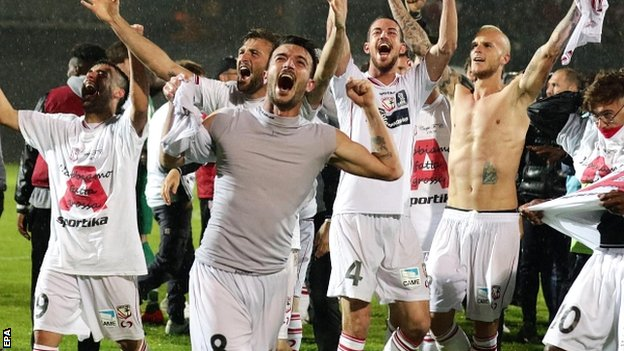
A small town club called Capri FC 1909, formed in 2002, have gained promotion to Italy’s premier league, Serie A, over the course of 5 seasons.

The club was formed from the ruins of the original which was plagued with bankruptcy and financial mismanagement.

In the year 2010 the club played its football in the Italian fifth division to a capacity stadium of 4,144 which may cause the club some difficulties next season as Serie A rules state that a club must have a minimum capacity of 20,000.

Hopefully, special exemptions will be made in honour of this remarkable achievement.

…..

THE JOURNEY

At the end of the 2009-10 season, due to the numbers of teams in financial difficulty, the club was admitted into Lega Pro Seconda Divisione (Division 4).

In 2011, the club obtained its promotion to the Lega Pro Prima Divisione (Division 3).

Then in 2013, the club made further progressions to Seria B (Division 2). This of course was the clubs third promotion in just four seasons.

On April 28th 2015 the club reached the holy grail of Italian football and gained promotion to the Serie A where they will play the likes of Roma, Inter Milan and Juventus. Carpi confirmed their place in Serie A with four games remaining of the season after a goalless draw against Bari last night.

Capri has a relatively small budget, and a payroll that fails to exceed 3 million euros making what they have achieved, something of a miracle.

Despite this high achievement, manager Cristiano Giuntoli insists that the clubs philosophy will not change; Carpi will continue to focus on youth players, and will engage fans by utilizing home – grown players.

Congratulazioni Capri e buona fortuna!

BLAUGRANA – Messi, Suarez and Neymar score a century! (Viel Glück Bayern München)

HISTORY HAS BEEN MADE TONIGHT AT THE NOU CAMP!!!

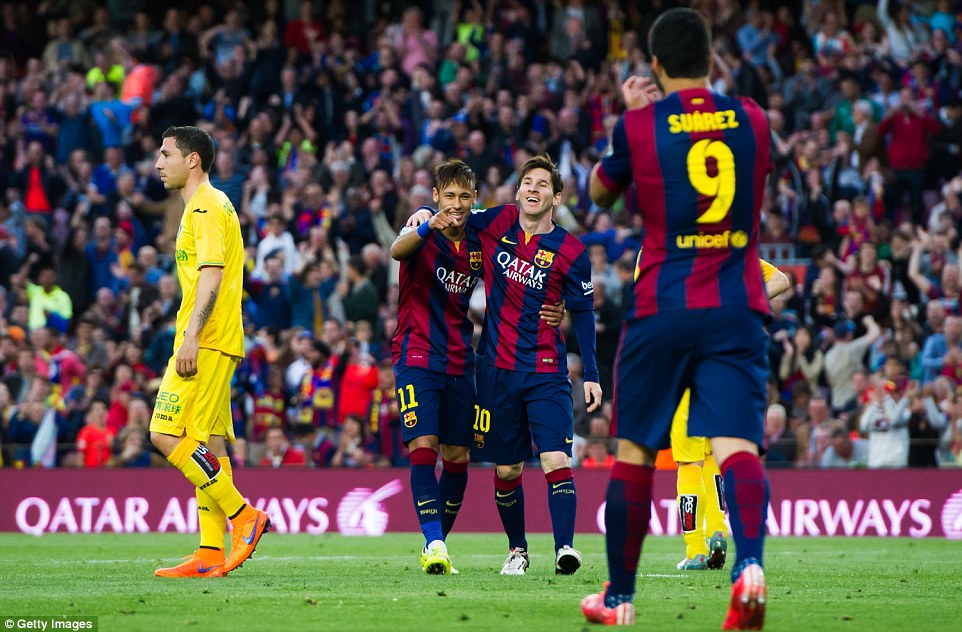
After a 6 – 0 win over Getafe arguably one of the greatest strike forces of all time, dMSNespite their short time together, surpassed the 100 goal tally for the season.

Lionel Messi, Luis Suarez and Neymar de Silver Santos Junior all scored tonight to reach the tally within 30 minutes of kick off.

Messi scored the opening goal from the penalty spot, and then Suarez doubled Barcelona’s lead on 25 minutes with a neat volley. Three minutes later Neymar joined the party, as the three amigos put on a show for the home crowd. Xavi scored the fourth goal on this his 501st appearance for his boyhood club.

Suarez scored his second just before half time, and the magnificent Lionel Messi ended proceedings with his second goal of the night. This victory leaves Barcelona leading the La Liga table 5 points ahead of rivals Real Madrid, who play on Wednesday night against Almeria. Barcelona look on course to regain their first La Liga title in three years.

MSN (Messi, Suarez, Neymar) have now scored a collective tally of 102 goals in all competition. This record has surpassed the previous 99 goal tally set by Samuel Eto’o, Thierry Henry and Lionel Messi during the 2008 – 2009 season.

Last season Real Madrid’s Karim Benzema, Cristiano Ronaldo and Gareth Bale came oh so close to beating the record set in 2008 with 97 goals, but unfortunately it was not enough and it will take something very special to beat the record 102 goals set by this exceptionally talented Blaugrana strikeforce.

102 goals and counting!

Viel Glück Bayern München! (Good luck Bayern Munich)

PAULA RADCLIFFE – Simply the Best!

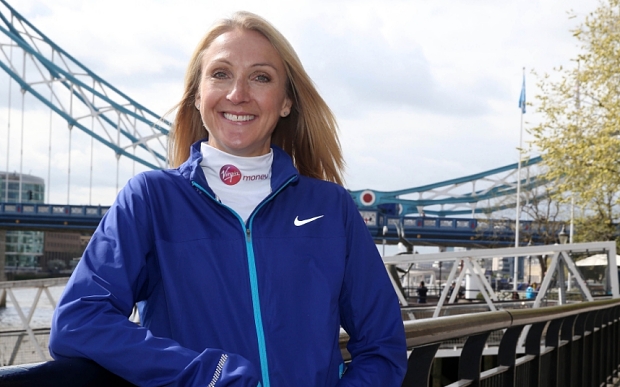
Virgin Money London Marathon Preview Press ConferencesTomorrow morning Paula Radcliffe, aged 41, will run her final competitive marathon at the scene of her greatest triumph as a long distance runner.

The Virgin Money London Marathon will be host to Radcliffe’s final act. It is the stage where in 2003 Radcliffe set the women’s record time at 2 hours, 15 minutes and 25 seconds. This is seen as one of the most imposing records in world athletics.

………..

Unfortunately Radcliffe has been forced to bow out of elite competition due to a recurring injury in her left foot however the legacy she has made leaves much to commemorate.

Paula Radcliffe has been a stand out figure in the fight against doping in elite sport. A year before her quite remarkable record beating run, the British athlete asked the International Association of Athletics Federations to increase the frequency of her doping tests.

Radcliffe’s physiotherapist, Gerard Hartmann, even insisted that Radcliffe would meticulously check her water bottles pre race to check that the bottles had not been contaminated without her knowing.

………..

Paula Radcliffe has been an outstanding British athlete; there is no one quite like her.

Radcliffe has won the London marathon 3 times in 2002, 2003 and 2005. She has done the same in New York in 2004, 2007 and 2008 also winning the Chicago marathon in 2002.

This great athlete has represented her nation in several international competitions including the European championships, World championships, the Commonwealth Games and the Olympic Games.

Sebastian Coe, the man behind the success of the London 2012 Olympic Games, has commented that Radcliffe is a pioneer of women’s sport and has made an impact on wider society, he said:

“She gave women permission to feel they could go out and run and be part of the London Marathon….A generation of runners, male and female, have taken up the sport because of Paula Radcliffe.”

………..

Radcliffe’s athletic success was testament to her tremendous fitness levels and unique tolerance for pain.

At the age of 17, sports scientist Andrew Jones discovered that a young Radcliffe possessed an unbelievable capacity for oxygen. Radcliffe, at such a tender age, had a VO2 max of 70. This is the highest of any female athlete. (VO2 Max = the maximum volume of oxygen an athlete can use)

Radcliffe was known to run, on average, a staggering 140 to 150 miles a week; running for hours on end in the morning and again in the afternoon.

A magnificent trainer, who pushed herself to the absolute limit, Radcliffe would refuse to simply step off the treadmill. Paula’s sport scientist, Andrew Jones said:

“When we are testing on the treadmill we ask people to tell us when they feel they have about a minute left to run,”

Jones continues….

“Paula would be clearly as exhausted as most athletes ever get but would signal she wanted to keep going. And this would keep going and going. She would rather have gone off the back of the treadmill than be stopped. She would push herself beyond what seemed possible.”

………..

Radcliffe would peak at the 2003 London Marathon, that day would be her golden moment in time.

Had things gone differently at the summer Olympic Games in Athens the following year Radcliffe believes herself that she would have broke her record.

Athens proved to be a difficult time for the British athlete. Prior to the competition Radcliffe was seen as the favourite to win gold in the women’s marathon. Three weeks before the competition Radcliffe was in the best form of her life. Coach and husband Gary Lough said:

“Three weeks before Athens she ran a tempo run of 24.4 miles in 2hr 15min at altitude,”

Lough continued…

“That was better than a similar run she had done before London. We knew she was in 2:13.45 to 2:14.10 form. She was in unbelievable shape, the peak of her career. That was when the rose had fully blossomed – and then she got injured.”

A freak accident would prevent Radcliffe competing to her full potential at the event in 2004. While out for a jog, a stone hit by a passing car fired into the knee of the athlete which caused a ‘clot and abscess’, and for two weeks Radcliffe was out of action.

Pumped with anti-inflammatorys her body was unable to metabolise food, leading to dehydration and white coloured bowel movements. Despite this, Radcliffe ran on but had to stop 22 miles into the race.

The British press branded Radcliffe a failure and a choker, unaware of her injury. Still most of this flack has continued to this day.

………..

Tomorrow morning on her return to the London Marathon, Radcliffe aims not to break her record but to run the race in under 3 hours, and to do so would be a huge send off and thank you to the fans and to the sport that she loves.

As an 11 year old girl visiting the marathon, a young Radcliffe was mesmerised by the performance of Norwegian runner, Ingrid Kristiansen. Since becoming a huge sporting success Radcliffe has commented on the inspiration she experienced that day saying:
“It broke down any barriers I had in my head….I thought: why can’t I be in there running and being competitive too?”

Perhaps tomorrow, that kid in the crowd will also say “Why not me?”

Throwback Thursday – The Sports Bra!

jogbraThis weeks THROWBACK THURSDAY is the ladies sports bra; a technology like no other that became a revelation to women all over the world.

Its inventor, Hinda Miller, had noticed the dangers for women who were running without efficient support around their breasts and had witnessed the horrific site of female runners bleeding from the nipples.

Running without the support was causing the tear of the Cooper ligament. This ligament is made up of connective tissue within the breast that helps to maintain structural integrity. A tear to this ligament can cause sagging to the breast, which may affect breast feeding and can cause further problems with the breast in later life.

After observing such a shocking image Miller, along with her two close friends Lisa Lindahl and Polly Palmer-Smith came up with an idea that would protect and support the breast – they called it the Jogbra.

The Jogbra was released in 1977. The inspiration behind the clothing was the male sports undergarment the jock strap. Lindahl and Smith sewed two jockstraps together which were to be placed across the rib cage aligning underneath the breast.

The sports bra has since been developed by leading sports manufacturers such as Nike, Adidas and Puma, who have all added their scientific advancements to the technology in order to improve breast support.

The success and the indispensible nature of the sports bra have been recognised by sports women world wide.

One such testament comes from 11 time British javelin champion, Goldie Sayers, who said:

“If I forgot my sports bra, forget it, I just wouldn’t compete.”

There is no question that the sports bra plays a vital role in sports participation rates for women, and particularly for young girls. A study conducted by the University of Portsmouth found that 1 in 5 women say their breasts stop them from participating in physical activity.

Further research shows that the majority of women and young girls who exercise on a regular basis don’t actually wear or own a sports bra.

It is very important that ALL women and young girls performing in sport, or who are engaged in a physically active lifestyle wear and regularly replace their sports bra, just like you would your shoes or other leisure wear.

Please educate women on protecting their breasts and increase your own awareness or friends and family members’ awareness of breast health.

GET YOUR OVER SHOULDER BOULDER HOLDER ON LADIES AND GET YOURSELF ACTIVE!!

YOUTH CULTURE IN POST WAR BRITAIN – CYCLE SPEEDWAY.

A sport called ‘CYCLE SPEEDWAY’ that began in Britain post World War 2 from the remains of the bomb sites that struck the island. The sport gripped the youth of the time, and became a cultural hit!

“The riders might only have been aged 16 and 17, but many became minor celebrities in their local area.”

Joe Foster, now 79, who raced for the Bermondsey Greyhounds and Lynton Lynx said:

“It was exciting – it would be absolutely chock-a-block, quite an atmosphere with people cheering you. I’d say there were more than 3,000 people sometimes,”

I WOULD HIGHLY RECOMMEND HAVING A READ AT THIS ARTICLE. QUITE A REMARKABLE STORY.

http://www.bbc.co.uk/news/magazine-31013387

Sabermetrics – Oakland Athletics and Moneyball

It’s THROWBACK THURSDAY so here is a little story all the way from the city of Oakland in the state of California, USA.

In there 2002 season the Oakland Athletics, and their then General Manager Billy Beane changed the world of sports and professional baseball forever.

By the year 2001, Billy Beane had been Oakland’s GM for four years and the club had a very limited budget in contrast to bigger franchise teams.

Oakland were working on a budget of $39,000,000 while the richest team the New York Yankees enjoyed a budget of $130,000,000.

During the off-season Beane and Oakland lost three of their key players: Jason Giambi, Johnny Damon and Jason Isringhausen. It was Billy’s job to turn what he believed was an unfair game into a fairer one, and so he, along with his assistant Paul DePodesta, used a roster selection system based on mathematics and science using statistical data, commonly known as sabermetrics created by Bill James.

Bill James, on paper, is a baseball writer, historian, and statistician, each year producing an annual abstract of Major League baseball statistics.

In reality though, Bill James is the man who challenged the entire American baseball industry.And in the 2002 season, many would say that he won.

That season the Oakland Athletics went on a 20 game winning streak. In the realms of baseball, this is unheard of, and on a $39,000,000 budget it was something of a miracle.

‘Moneyball’ was taking the sport to greater places.

Oakland lost the division series that year to the Minnesota Twins, the team who also ended their 20 win game streak, however following the success of sabermetrics the New York Mets, New York Yankees, San Diego Padres, St. Louis Cardinals, Boston Red Sox, Washington Nationals, Arizona Diamondbacks, Cleveland Indians and the Toronto Blue Jays have hired full-time sabermetric analysts.

Many in baseball will never accept the premise of ‘Moneyball’, and value only traditional methods of scouting and selection.

However, it is very clear given the success of the 2002 Oakland Athletics on such a small budget and the impact that the system has had on teams that possess great wealth that baseball was changed forever.

Thanks to Bill James, Billy Beane and Paul DePodesta an unfair game was made that bit fairer.

Video below of the 20 game winning streak. I realise it’s long but for sheer entertainment value and one of the greatest American sporting moments you will ever witness watch the final game on 23:30. One of the greatest come backs in sports history, and one of thee greatest and harshest wins. A golden sporting moment.

The Masters – Golf

It would be criminal to ignore one of the world’s best sporting events….The Masters!

The Masters, one of golf’s four major tournaments, has been running for 81 years. The inaugural tournament held in 1834.

It is the only golf major to be hosted in the same venue every year – the infamous Augusta National Golf Club right in the heart of Georgia in the United States of America.

Traditionally the winner of The Masters is presented with ‘the green jacket’.

Jack Nicklaus has the most Masters wins, winning 6 between 1963 – 86. Arnold Palmer and Tiger Woods have won 4 Masters tournaments, while Jimmy Demaret, Sam Snead, Gary Player, Nick Faldo, and Phil Mickelson have all won 3.

It took 27 years for the first non – American golfer to win the Masters. South African golfer, Gary Player, won the tournament in 1961. It took a further 19 years for Seve Ballesteros of Spain to emulate Player. Ballesteros won in 1980 & 83.

The Masters oldest winner is Jack Nicklaus, who was 46 years old when he won in 1986. The youngest winner, Tiger Woods, was only 21 when he won in 1997.

In 2013, Guan Tianlang became the youngest player ever to compete in the Masters, at age 14 years

Who will win this year? Like, comment, share, ignore, do what you like….ONE LIFE!

“WE COULD HAVE HAD TEN” – THE WEMBLEY WIZARDS, 1928

ON THIS DAY:

31st March 1928. Some 87 years ago, Scotland played England in the British Home Championship at a packed Wembley Stadium (80, 868).

Scotland in their previous two fixtures had lost 1 – 0 to Northern Ireland, and drew 2 – 2 with Wales. England also failed to get off to a successful start losing to both Northern Ireland and Wales.

Despite Scotland being a point ahead of the ‘Auld Enemy’, the Scots still feared they would finish bottom of the table facing the challenge of beating England, the previous winners of the British Home Championship, on home soil.

If the thought of facing the previous winners wasn’t fearful enough, the team selection certainly was. Left out of the 11 man squad were Davie Meiklejohn (Rangers FC, 409 app), Jimmy McGrory (Celtic FC, 378 app and 395 goals), Bob McPhail (Rangers FC – record of 230 goals only to be beaten by Ally McCoist in 1997) and Willie McStay (Celtic FC, 4 League titles and 3 Scottish Cups).

These players were considered as HOME SCOTS, players who were Scottish who played in the Scottish Football League.

The players that were favoured were the ANGLO SCOTS, Scottish players who played their football around other parts of Britain.

In place of the HOME SCOTS were 8 Football League players. One of which was Tom ‘Tiny’ Bradshaw who would be making his Scotland debut at Wembley against the famous Dixie Deans.

Dixie made 399 appearances for Everton, scoring 349 goals.

Scotland, inevitably, were deemed NO MATCH FOR ENGLAND!

That was until the rain.

Scotland’s captain, Jimmy McMullan, took his team for a talk the night before the game. He famously said:

“The President wants us to discuss football but you all know what’s expected of you tomorrow. All I’ve got to say is, go to your bed, put your head on your pillow and pray for rain.”

It did nae rain but it POURED!!

The rain was always going to favour the small Scots who could easily twist and turn away from the tall men of England.

3 minutes!! 3 minutes in and the Scots had taken the lead with an Alex Jackson header.

Just before half time and the Scots went 2 – 0 up through an Alex James left footed shot.

You wouldn’t believe what you were seeing.

This was never meant to happen. Every pundit in the world would have put their granny on England to win!

Even the Scottish fans! In fact some of them probably did.

Jackson grabbed his second on the 65th minute, as did James in the 74th minute, and Jackson rounded off the hat trick in the 85th.

England would end the game with a mere consolation goal.

The game would finish 5 – 1 to the Scots. The Wembley Wizards had been born.

Sadly this great team would never play together again and for Tony Bradshaw, despite keeping Everton’s son Dixie Deans at bay, it would be his only cap for Scotland.

These players will forever go down in history as giving one of Scottish Footballs greatest ever performances in the dark blue. It was one of thee most remarkable victories of its time, and 87 years on it remains one of the Scots best victories against England.

The 1928 Wembley Wizards:

Jack Harkness (Queens Park)
James Nelson (Cardiff City)
Tommy Law (Chelsea)
Jimmy Gibson (Aston Villa)
Tom Bradshaw (Bury)
Jimmy McMullan (Manchester City) CAPTAIN
Alex Jackson (Huddersfield Town)
James Dunn (Hibernian)
Hughie Gallagher (Newcastle United)
Alex James (Preston North End)
Alan Morton (Rangers FC)

REMEMBER THE NAME. REMEBER THE HEROES.

“Scotland, Bonnie Scotland – Forever”