Uncategorized

WHO ATE AWW’ THE PIES?!

This afternoon Leeds United supporters will conduct a protest against a ‘PIE TAX’ when they face Hull City at Elland Road in the Yorkshire Derby (3pm KO).


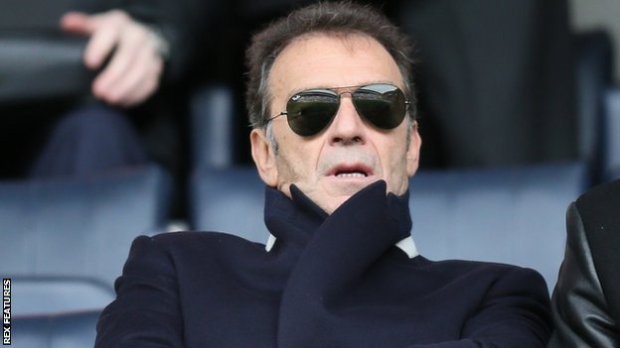
Leeds owner, Massimo Cellino, has increased the ticket price of the South Stand by £5. This £5 increase will include a food voucher, intended as an incentive to encourage supporters to use the clubs catering facilities.


The fans are simply outraged at the owners’ decision to enforce the new ticket price, without consultation.


This new price will be applied to today’s fixture against Championship rivals, Hull City. Supporters in the South Stand will now be obliged to pay an increased price of £32 for the luxury of watching their home side, in contrast to supporters in the North Stand who will pay the usual £27. However, they will have the comfort of a half time pie – this is assuming that the loyal supporter wants to eat a pie at half time.


To be honest this incentive provides more ammunition for the case of Fan Ownership in football. This ‘pie tax’ surely has to be the last straw for a football club who for the worst part of 15 years have suffered from financial mismanagement and poor ownership. To pay an extra fiver for the price of your ticket you would be expecting a better seat, better players, or a better manager. This is simply ludicrous governance. I would think if you were seeking to encourage supporter attendance, and overall buy in from the support, then you would sell tastier pies at a reduced cost. But that seems too far fetched.


Owner, Massimo Cellino, is by no means a popular figure at Elland Road. His controversies have lead to the Football League banning the chairman from running the club on not one but two separate occasions. The first ban occurred in December 2014, after Italian courts found the owner guilty of tax evasion. The chairman appealed against the decision but was unsuccessful. The second ban occurred in October 2015. Again, the owner submitted an appeal against the decision but it appears he has so far been unsuccessful. Finally, to cement his undying love for Leeds United, last month the chairman vowed to no longer attend fixtures and removed his interest in selling the club to the supporters group, Leeds Fans United.


It is clear that Cellino has no loyalty to the club, and shows complete contempt to the Leeds support. The Whites have been made to endure the hardest of times and it goes without saying that they simply deserve more.


There is no question that the club would have fell to rubble by now had it not been for the loyalty of the fans. Football clubs are like no other business on the planet. If you use a product and you don’t particularly like it, then you change it and try a new one. This does not happen in football. Football is part of our identity, it is our cultural grandstand. The Leeds fans have proved this today. Even with the ‘pie tax’ the loyal support SOLD OUT their South Stand, and every home fixture welcomes 20,000 loyal whites. These supporters MUST be rewarded for their undying and lasting loyalty to their football club.


Leeds United is far from the riches and royalties of the Premier League; the club currently sits 17th in the Championship. The supporters must fight their majority share holder, Cellino, and take over the governance of their once proud club. For too long they have suffered at the hands of turbulent mismanagement, discouraging the club from gaining any form of stability or transparency. Perhaps a greater victory would be to win the battle, and for now, lose the war.


http://www.bbc.co.uk/sport/0/football/35006222


http://www.telegraph.co.uk/sport/football/teams/leeds-united/11951721/Massimo-Cellinos-ever-changing-moods-are-holding-Leeds-United-hostage.html


http://www.telegraph.co.uk/sport/football/teams/leeds-united/12032063/Leeds-Uniteds-pie-tax-is-an-abuse-of-supporters-loyalty.html


http://metro.co.uk/2015/12/03/leeds-united-owner-introduces-mandatory-pie-tax-for-supporters-buying-a-match-ticket-5541279/


http://www.bbc.co.uk/sport/0/football/34721028


http://www.yorkshirepost.co.uk/sport/football/hull/despite-pie-tax-leeds-south-stand-sold-out-for-hull-derby-1-7606384


“We’re top of the League and you’re no!”

Leicester City climbed to the top of the Premier League today with a 3 – 0 win over Newcastle United. The Foxes have successfully bagged 28 points in 13 games, sitting 2 points above last season’s league winners Manchester City. Surprisingly, this time last season Leicester were sitting bottom of the table, facing imminent relegation. Leicester City have scored in 14 consecutive league games, and on form striker Jamie Vardy has scored 10 goals in 10 games equalling Dutch star Ruud van Nistelrooy’s tally of successive goals, with the former Red Devil also scoring his 10th against Newcastle United at St James Park in 2003.

The Foxes came close to winning the biggest prize in English Association Football in 1929, only to finish the season as league runners up to eventual winners Sheffield Wednesday. But with a phenominal start to the season and no sign of Claudio Ranieri’s team dropping the ball anytime soon the anticipation and excitment is growing South of the border. Could this be Leicester City’s year, and will Jamie Vardy’s run of form ever end?

FOXES NEVER QUIT

PS. Good luck Manchester United, and Louis van Gaal.

Homophobia in Football: What’s the problem?

(I would like to highlight that the following information is drawn from a football perspective within England)


“If a player did come out, I think everyone would be supportive, but I’m 100% sure that people in the changing room would be joking, and that some would be ripping it out of him.  If there’s a gay player in our changing room, I’d understand why he wouldn’t come out.”

(Anonymous, professional League One player)


BBC Sport reported yesterday that Premier League executive Richard Scudamore supports the idea that openly gay footballers would be treated with respect in the Premier League.


This was a bold assumption from Scudamore, who has held his position as Chief Executive at the top flight of English Association Football for 16 years. Scudamore believed openly gay footballers would be treated with “tolerance” and “that the time would be right” to come out.


The Chief Executive however appeared ill informed on the subject. When discussing the gay footballer “coming out”, Scudamore questioned whether this language was appropriate and consistently referred to openly gay players as “them” and “they”.


There is only one openly gay player in English football. His name is Liam Davis, and he plays for Gainsborough Trinity. In an interview with BBC Sport in January 2014 Davis spoke about a fairly positive response from his team mates, opposition and fans. Davis stated that on the one occasion that he did encounter abuse from an opposition player, the player apologised for his behaviour after the match via a text message. During an interview with the Lincolnshire Echo Davis expressed his wishes that professional footballer Thomas Hitzlsperger would have “came out” before retiring in 2013. Davis did however admit, that the closer you get to the top flight then the harder it will be for players to be open about homosexuality due to greater media coverage and increased fan exposure. Davis seemed to be in the perfect community club environment to “come out”, and has received massive support from family, friends, team mates and the football club itself. However, the same cannot be said for others. And the fact of the matter is, out of the 2 million adults who participate in football every week in England only one is openly gay despite 1.5% of the English population being homosexual or bisexual. This does not support Scudmore’s statement, and it is plainly obvious that the environment in England is not entirely suitable for homosexual footballers.


Thomas Hitzlsperger, the former Aston Villa and German national player, also received positive responses upon coming out to the public.  This is a great thing, however Hitzlsperger never experience a match day response inside a Premier League stadium. So there is no telling how a crowd would respond. I would like to think the reaction would be positive, but past experience tells us otherwise. Justin Fashanu, England U21 International, came out as homosexual in 1990 – he was the first footballer to do so in the United Kingdom. He committed suicide at the age of 37, tragically, as a response to his sexuality.


Fundamentally, the difficulty with this subject is that gay footballers are the invisible minority. Popular football magazine FourFourTwo reported a survey of professional footballers who responded to the question, “Do you know any gay players?” 11% of the 123 players asked responded “Yes”.  (Please note that some Scottish Premier League players responded to this survey)


“A player confided in me and came out. I’ve kept my mouth shut. It’s none of my business. It’s no one’s business.”


This one response from a professional League Two player highlights the eagerness to protect gay footballers. This may seem like an act of kindness, but personally I believe this suggests a lack of tolerance in the English game.


The Gay Football Supporters Network (GFSN) was formed in 1989, “as a social network for LGB&T football fans across the UK.” The organisation uses football as a tool to tackle “homophobia, biphobia, and transphobia” on and off the football field. It has helped to establish LGBT supporters clubs, assisting the development of an inclusive and equal football fan experience. London based clubs, Arsenal FC and Tottenham Hotspurs, are two such clubs with LGBT supporters groups. The Gay Gooners and The Proud Lilywhites are the clubs official LGBT fan communities. These fierce rivals share solidarity and a common goal to create a safe and inclusive fan environment. BBC Newsbeat investigated LGBT supporters clubs in the Premier League in August this year. Excluding Arsenal FC, who formed the first Premier League LGBT group in 2013, BBC Newsbeat asked the remaining 19 clubs “if they had an official one connected with the club”. From the 11 respondents, 4 chose not to answer the question, 5 said that yes they did have LGBT fan groups and the remaining two stated that they didn’t have one at the current time.


Proud Lily Whites.jpg


GFSN have stressed that Premier League clubs are not doing enough to support their fans. Ed Connell, GSFN Chairman, is shocked at the number of Premier League clubs and officials (such as Richard Scudamore) who believe that homophobia in football is not a problem. Out of the Fields conducted the first International Study on homophobia in sport. The results were posted in May this year and despite the majority opinion, out of more than 9,000 people in the United Kingdom 77% claimed they had “witnessed or experienced homophobia in sport”.


Back to Richard Scudamore, the man who places blind faith on football and football fans to “tolerate” homosexuality. The statistics show little proof that coming out will be welcomed in English football. I hope I am proven incorrect, but I simply cannot support Scudamore’s thoughts. It is clear that we have a number of gay footballers who do not want to come out, for whatever reason. Clearly they are known to other professionals who they work with on a daily basis but they will not expose themselves to fans or the media. This highlights a significant problem with homosexual inclusion in English sport, particularly football. This problem isn’t exclusive to the football players alone, and football fans are seeking new ways to enjoy the sport that they love. Homosexual, bisexual and transgender fans are forming LGBT supporters groups in order to feel safe in Premier league grounds, and yet clubs, officials and executives are still denying that there is a problem. Without a shadow of a doubt Scudamore’s comments are ill informed and misjudged. I cannot say that I am a member of an LGBT group, but if I was I would not be very happy with my league executive for completely downplaying a very serious problem within football.


Reference


http://www.lincolnshireecho.co.uk/Gainsborough-Trinity-s-Liam-Davis-openly-gay/story-20431222-detail/story.html


http://www.theguardian.com/politics/reality-check/2013/oct/03/gay-britain-what-do-statistics-say


http://news.bbc.co.uk/1/hi/uk/87288.stm


http://www.gfsn.org.uk/news/beta-gay-players-11-of-players-know-one.html


http://www.tottenhamhotspur.com/news/formation-of-lgbandampt-fan-group-060214/


http://www.arsenal.com/fanzone/gay-gooners


https://proudlilywhites.wordpress.com/


http://www.bbc.co.uk/newsbeat/article/33760649/footballs-lgbt-fans-want-more-help-from-clubs


http://outonthefields.com/


Half and half shirts: what’s the problem?

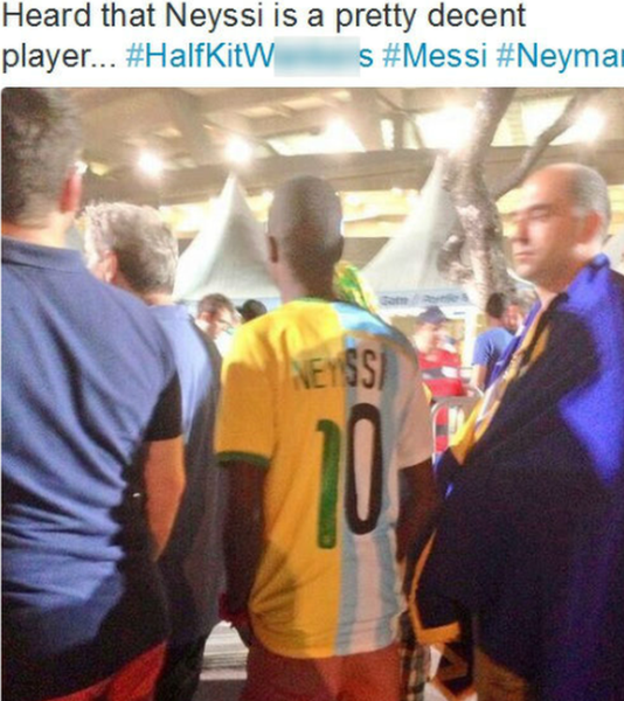
_86486330_halfhalf1A wind – up? An expression of dual identity? Or an expression of the impact of the global football market?
Many ridicule such an image, of a ‘football fan’ sporting a shirt with two club emblems on the chest, however you may be more alike than first thought.
How many people can truly say now that they support their local team? How many people even support their regional, or indeed their national team?
There is an ever increasing number of football fans supporting teams who occupy Europe, predominantely teams from Europes BIG FIVE, notably in Germany, Spain, Italy, France and England.
Mass media has allowed us to be consumed by football events, heroes and villians. Everyday we are emerged in a spectacle of footballing prowess, and those teams with the greatest amount of money and the greatest amount of power possess the loudest voice in our social world. It is therefore probable to assume that football is no longer as community based and tribal as it once was. Globalisation and immigration has been a huge factor in this also.
Is this a good thing?
Many people agree, and feel positively about getting away from footballs ‘tribal’ elements. Possibly believing it will alleviate violence, and ethinic difference.
Is it a bad thing?
Well it is changing the culture of the game. Fans are now involving themselves in the business of football like never before, and are being commodified by the vast media market. This goes against the age old tradition of being ‘born’ a fan which is charaterised by common footballing tales such as ‘cut me and i’ll bleed (insert team colours)’, ‘my Dad was a (insert team name) fan, so I am’ or ‘I was born here, so I support (insert team name)’.
Traditional fans don’t like this commodification of football fans, and more importantly they don’t like that “fans” are buying into it. Many struggle with the concept of having a ‘second team’. To many it’s unthinkable, but in the modern world it’s ordinary.
IMO.
I would love to live in a world without sky sports. I would love to have seen an international match with a minimum of 100,000 people standing under one roof watching the sport I love (From 1906 – 1914 Scotland v England managed this feat: never less than 100,000 attendance during this time).
Alas, these are changed days and we live in the age of digital media. However, I must side with the traditionalists. With dwindelling numbers at football grounds, and complete lack of local and national talent in the United Kingdom I only worry that collective identities soon become extinct. Of course football must celebrate multiculture diversity, which football has aspired to since the Bosman ruling (1995), but it should never lose sight of local and regional pride and identity.
All that from one kit, eh?
PLEASE LEAVE COMMENTS AND THOUGHTS BELOW.

British Association Football

History comes to life today in Scotland and England as 4 teams battle it out to win their respective national football tournament. 

The Scottish Cup was first held in 1873.  The trophy presented to the winner of the competition is the oldest in association football and the oldest national trophy in the world. The first team to win the Scottish cup was Queen’s Park in March 1874.

The first ever Scottish cup game was won by Kilmarnock, who beat opposition Renton 2 – 0.

The most successful club in this competition is Celtic, who have won the worlds oldest trophy 36 times.

The Football Association Challenge Cup ( commonly known as the FA cup ) is the oldest association football tournament in the world. The inaugural tournament was held in 1971.

Arsenal were the winners of the 1971 tournament.

Arsenal and Manchester United are joint leaders of the record number of tournament wins. Both sides have 11 FA Cup wins to their name.

SPORT AND POLITICS: FROM THATCHER TO CAMERON – WHO WILL BE NEXT?

British politics has not always had an interest in sport. Even now many involved in politics feel that the two should never mix.

For a long time it never did. A huge step was taken in 1972 when the Sports Council (now known as UK Sport) was established in Britain.

This organisation launched the ‘Sport for All’ campaign. The aim behind it was to promote wider public awareness of the value of sport across the United Kingdom. ‘Sport for All’ wielded a dual message; it wished to promote access to sport for marginalised or disadvantaged groups, such as women, the disabled or those of a low socio-economic status, furthermore ‘Sport for All’ wished to promote sport as a part of everyone’s day to day life.  Over the course of the campaign new facilities where built to offer sport provision, or there was simply improvements made to existing facilities.

The establishment of the Sports Councils for a short time provided a positive step for sport. All would soon change under Thatcher’s Conservative Party.

MARGARET THATCHER: The Iron Lady

Margaret Thatcher, the woman that would change it all.

Lady Thatcher, and the Conservative party, would form the role as British Prime Minister for 11 years from 1979 – 1990.

Beginning with the 1980 Moscow Olympics, Thatcher desired all British athletes to boycott the international sporting event because the Soviet Union invaded Afghanistan in 1979. That GB athletes that did attend, did so without government support.

Thatcher was ever keen to reduce public spending would never allow for a home Olympics. When Birmingham bid for the 1992 Commonwealth Games, it did so without financial support from the government.

Thatcher and Football were two words that certainly did not mix well. Following two “crowd disaster” in 1985 (Heysel and the Bradford Fire) Thatcher and her Conservative government introduced fan ID cards under the Football Spectators Act of 1989. The ID cards were required by fans to gain admission to football grounds in Britain.

Critics of the scheme complained that a vast majority of supporters may have been law-abiding citizens. There were also technological difficulties associated with the cards and heavy queuing was another major issue.

The Prime Minister also failed to consider the possibility that most disturbances were outside grounds rather than inside.

Hillsborough would be the final “crowd disaster” that would lead to the abolishment of the ‘National Membership Scheme’.

School Sport, and the work of the Sports Councils, was to take a heavy toll during the Margaret Thatcher era. The Prime Ministers 1981 Regulation 909 gave education authorities the right to sell school land that they considered surplus to their requirements. Over the next decade an estimated 5,000 playing fields were sold, many converted to housing developments, supermarkets or car parks.

A survey by the Secondary Heads Association showed that the proportion of pupils under 14 spending less than two hours a week in physical education rose from 38% to 71% between 1987 and 1990, a shocking statistic which completely summarises Thatcher’s indifference towards sport.

JOHN MAJOR: The sports fan not without failure

John Major, and the Conservative party, would succeed Margaret Thatcher and form the role as British Prime Minister for 7 years from 1990 – 1997.

Major aimed to place sport at the top of the Westminster agenda. He believed that School Sport was the first step towards a lifetime participation in sport. To achieve lifetime participation John Major aimed to provided links been school and club sport.

Sport: Raising the Game released in 1995, was to be the Conservative Party’s new sports policy plan. The plan committed to correcting Thatcher’s failure and looked to reinstate a minimum of 2 hours a week dedicated to Physical Education and School Sport for ALL children. Traditional British sports and team games would be central to the plans. The cultural heritage surrounding team sports in Britain was to be used to promote pro school values and character building.

Under Major’s Conservative government huge funding was put aside for the provision of extracurricular activities and school – club links. The establishment of the National Lottery in 1992 was used for this exact purpose. The Lottery funds were to be split amongst the UK Sports Councils with the sole purpose of providing school sport.

Under Major sport appeared to be in good hands, however there are issues with his policy.

Major valued traditional, team games and while this appeared to be harmless in reality it divided genders. ‘Traditionally’ boys played rough, competitive, tactical games like football or rugby while girls played low intensity, aesthetically pleasing, technical games like netball and gymnastics.  The plan was critiqued for not engaging everyone at school level.

The idea of ‘traditional’ school sport mirrored Victorian ideology that resided in the English public and Scottish private schools. The plan was deemed as ‘more of the same for the more able’.

TONY BLAIR: The Game Plan

Tony Blair, and the Labour party, would succeed John Major, and form the role as British Prime Minister for 10 years from 1997 – 2007.

It was now Labour’s turn to create an inclusive and proactive sports environment in Britain. The Game Plan was Blair’s proposal for improving sport in the UK. For the first time in British history the plan outlined physical activity objectives.

Sport under Blair’s Labour government was going to be used as a tool to benefit not only education but wider society. Sport would be used to benefit UK health, crime, social inclusion and educational outcomes. The Game Plan strategy sought to increase opportunity equality, allowing people to participate within the social structures of British society. Blair’s plan targeted women, the elderly, school leavers and economically disadvantaged groups.

It was estimated that £2 billion was the cost of physical inactivity each year. Physical Activity and Sport would be the miracle cure for chronic diseases. Labour admired sport as a money saving tool; it provided a preventative medicine which in the long run would decrease NHS costs.

The Game Plan outlined the value that Blair placed on International sport participation and success. He believed a successful sporting nation created a ‘feel good factor’ that could have incalculable benefits on British people.

However, it would be too simple to say that Tony Blair’s Labour party had got it entirely right. It is very difficult to evaluate the success the Game Plan had on social inclusion for obvious reasons. Furthermore, its success in the area of improved educational outcome can be questioned.

It appeared that many leading educational organisations jumped on the bandwagon in support of educational improvement. The Qualification and Curriculum Authority (QCA) attached themselves to Labour’s Game Plan as did Youth Sport Trust (YST). However there could be many reasons for this.

Perhaps to be seen that they are doing there jobs right, the QCA agreed that the strategy was working. They were hardly going to disagree. Similarly the YST who aims to increase sport opportunities for all young people, working within the realms of social inclusion, were never going to oppose the “success” of Blair’s Game Plan.

GORDON BROWN: Competitive School Sport, the Revival

Gordon Brown, and the Labour party, would succeed Tony Blair, and form the role as British Prime Minister for 10 years from 2007 – 2010.

Competitive School Sport was Brown’s war cry following the news in 2005 that London would host the 2012 Summer Olympic Games. Brown’s Labour government channelled the use of new school sport such as cycling, canoeing and boxing in order to broaden inclusion and improve participation rates.

His proposal set out to increase the minimum 2 hours of Physical Education to a weekly 5 hours of PE time. This proposal however has not since been met. It was a fairly unrealistic proposal which would require a huge increase in volunteers and specialised teaching staff.

As for the use of new sports such as canoeing and boxing well there is very little evidence to suggest that they have been used in the British school system. The equipment and facilities required, not even mentioning the specialist coaching, was far beyond the reach of Gordon Brown.

DAVID CAMERON: Cuts to school sport – A Conservative Carbon Copy

David Cameron, and the Conservative party, would succeed Gordon Brown, and form the role as British Prime Minister for 5 years from 2010 – present.

Cameron faced the hard task of attempting to continue an Olympic Games Legacy after the success of the home nation event. This is a task that the current Prime Minister has never really accomplished.

Cameron and the Conservative government in their first year in power backed major cuts for school sport partnerships, which had helped to increase the quality and range of sport available in schools.

Ironically, for a government that values competition, competitive sport between schools has suffered after Cameron cut school sports partnership funding.

The £162 million annual funding for school sports partnerships was cut in October 2010. However, with such a backlash the Conservative government had to make a partial U-turn which resulted in a £65 million a year investment in school sport. This however would only last until the year 2013.

Cameron and his love of ‘competitive sports’, like Major’s Sport: Raising the Game policy, can cause mass exclusion. Again a Conservative government singled out talented and sporty pupils, while ignoring the indifferent. This would be another downfall discrediting the Olympic game legacy.

Cameron, after dismissing the idea of reintroducing the 2 hour Physical Education target, because schools were meeting it “by doing things like Indian dance or whatever, that you and I probably wouldn’t think of as sport”, provided a new draft PE curriculum published in 2012 that will make it compulsory to take part in what his Conservative party believe to be “recognised and recognisable sports” such as football, hockey and netball.

This may well be a carbon copy of Major’s Conservative ‘Traditional’ Sports Policy, the difference being that John Major placed a fair amount of funding behind sport. Cameron obviously has different plans for his purse, and indeed he was not the man to “Inspire a Generation”.
Congratulazioni Capri e buona fortuna!

SPORTS HISTORY MADE IN ITALY!!Capri 1909 serie A promotion 2015

A small town club called Capri FC 1909, formed in 2002, have gained promotion to Italy’s premier league, Serie A, over the course of 5 seasons.

The club was formed from the ruins of the original which was plagued with bankruptcy and financial mismanagement.

In the year 2010 the club played its football in the Italian fifth division to a capacity stadium of 4,144 which may cause the club some difficulties next season as Serie A rules state that a club must have a minimum capacity of 20,000.

Hopefully, special exemptions will be made in honour of this remarkable achievement.

…..

THE JOURNEY

At the end of the 2009-10 season, due to the numbers of teams in financial difficulty, the club was admitted into Lega Pro Seconda Divisione (Division 4).

In 2011, the club obtained its promotion to the Lega Pro Prima Divisione (Division 3).

Then in 2013, the club made further progressions to Seria B (Division 2). This of course was the clubs third promotion in just four seasons.

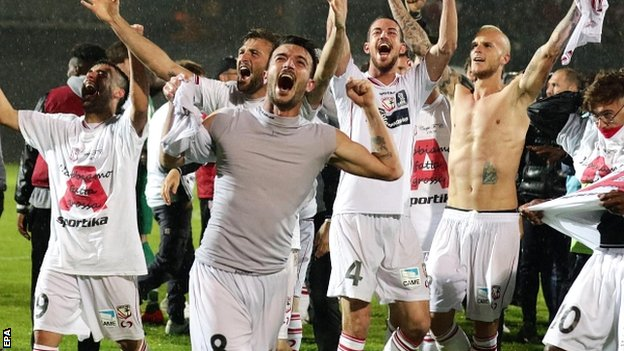
On April 28th 2015 the club reached the holy grail of Italian football and gained promotion to the Serie A where they will play the likes of Roma, Inter Milan and Juventus. Carpi confirmed their place in Serie A with four games remaining of the season after a goalless draw against Bari last night.

Capri has a relatively small budget, and a payroll that fails to exceed 3 million euros making what they have achieved, something of a miracle.

Despite this high achievement, manager Cristiano Giuntoli insists that the clubs philosophy will not change; Carpi will continue to focus on youth players, and will engage fans by utilizing home – grown players.

Congratulazioni Capri e buona fortuna!

BLAUGRANA – Messi, Suarez and Neymar score a century! (Viel Glück Bayern München)

HISTORY HAS BEEN MADE TONIGHT AT THE NOU CAMP!!!

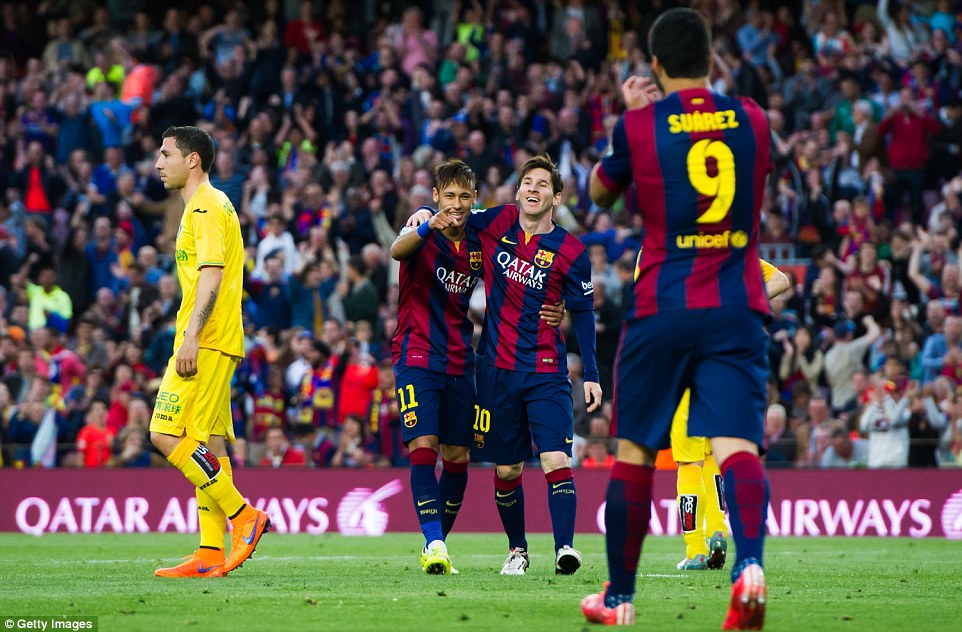
After a 6 – 0 win over Getafe arguably one of the greatest strike forces of all time, dMSNespite their short time together, surpassed the 100 goal tally for the season.

Lionel Messi, Luis Suarez and Neymar de Silver Santos Junior all scored tonight to reach the tally within 30 minutes of kick off.

Messi scored the opening goal from the penalty spot, and then Suarez doubled Barcelona’s lead on 25 minutes with a neat volley. Three minutes later Neymar joined the party, as the three amigos put on a show for the home crowd. Xavi scored the fourth goal on this his 501st appearance for his boyhood club.

Suarez scored his second just before half time, and the magnificent Lionel Messi ended proceedings with his second goal of the night. This victory leaves Barcelona leading the La Liga table 5 points ahead of rivals Real Madrid, who play on Wednesday night against Almeria. Barcelona look on course to regain their first La Liga title in three years.

MSN (Messi, Suarez, Neymar) have now scored a collective tally of 102 goals in all competition. This record has surpassed the previous 99 goal tally set by Samuel Eto’o, Thierry Henry and Lionel Messi during the 2008 – 2009 season.

Last season Real Madrid’s Karim Benzema, Cristiano Ronaldo and Gareth Bale came oh so close to beating the record set in 2008 with 97 goals, but unfortunately it was not enough and it will take something very special to beat the record 102 goals set by this exceptionally talented Blaugrana strikeforce.

102 goals and counting!

Viel Glück Bayern München! (Good luck Bayern Munich)

Throwback Thursday – The Sports Bra!

jogbraThis weeks THROWBACK THURSDAY is the ladies sports bra; a technology like no other that became a revelation to women all over the world.

Its inventor, Hinda Miller, had noticed the dangers for women who were running without efficient support around their breasts and had witnessed the horrific site of female runners bleeding from the nipples.

Running without the support was causing the tear of the Cooper ligament. This ligament is made up of connective tissue within the breast that helps to maintain structural integrity. A tear to this ligament can cause sagging to the breast, which may affect breast feeding and can cause further problems with the breast in later life.

After observing such a shocking image Miller, along with her two close friends Lisa Lindahl and Polly Palmer-Smith came up with an idea that would protect and support the breast – they called it the Jogbra.

The Jogbra was released in 1977. The inspiration behind the clothing was the male sports undergarment the jock strap. Lindahl and Smith sewed two jockstraps together which were to be placed across the rib cage aligning underneath the breast.

The sports bra has since been developed by leading sports manufacturers such as Nike, Adidas and Puma, who have all added their scientific advancements to the technology in order to improve breast support.

The success and the indispensible nature of the sports bra have been recognised by sports women world wide.

One such testament comes from 11 time British javelin champion, Goldie Sayers, who said:

“If I forgot my sports bra, forget it, I just wouldn’t compete.”

There is no question that the sports bra plays a vital role in sports participation rates for women, and particularly for young girls. A study conducted by the University of Portsmouth found that 1 in 5 women say their breasts stop them from participating in physical activity.

Further research shows that the majority of women and young girls who exercise on a regular basis don’t actually wear or own a sports bra.

It is very important that ALL women and young girls performing in sport, or who are engaged in a physically active lifestyle wear and regularly replace their sports bra, just like you would your shoes or other leisure wear.

Please educate women on protecting their breasts and increase your own awareness or friends and family members’ awareness of breast health.

GET YOUR OVER SHOULDER BOULDER HOLDER ON LADIES AND GET YOURSELF ACTIVE!!